Southeast Asia's infrastructure market continues to expand. The region's tropical marine environment—characterized by high heat, humidity, and salt spray—places stringent demands on the corrosion resistance of fasteners. In this market, coating selection and salt spray test specifications are not decorative contract clauses; they are core parameters that determine the service life of structural components.
Coating and Salt Spray Testing Framework Under ISO Standards
International criteria for evaluating the corrosion resistance of fasteners are primarily based on two ISO standard systems. ISO 9227 specifies the methodology for the Neutral Salt Spray (NSS) test: under a constant temperature of 35°C, a 5% sodium chloride solution is continuously sprayed as mist to record the time points at which white rust and red rust appear on the coating. ISO 4042 defines the correlation between coating thickness and corrosion resistance levels specifically for electroplated zinc-coated fasteners.
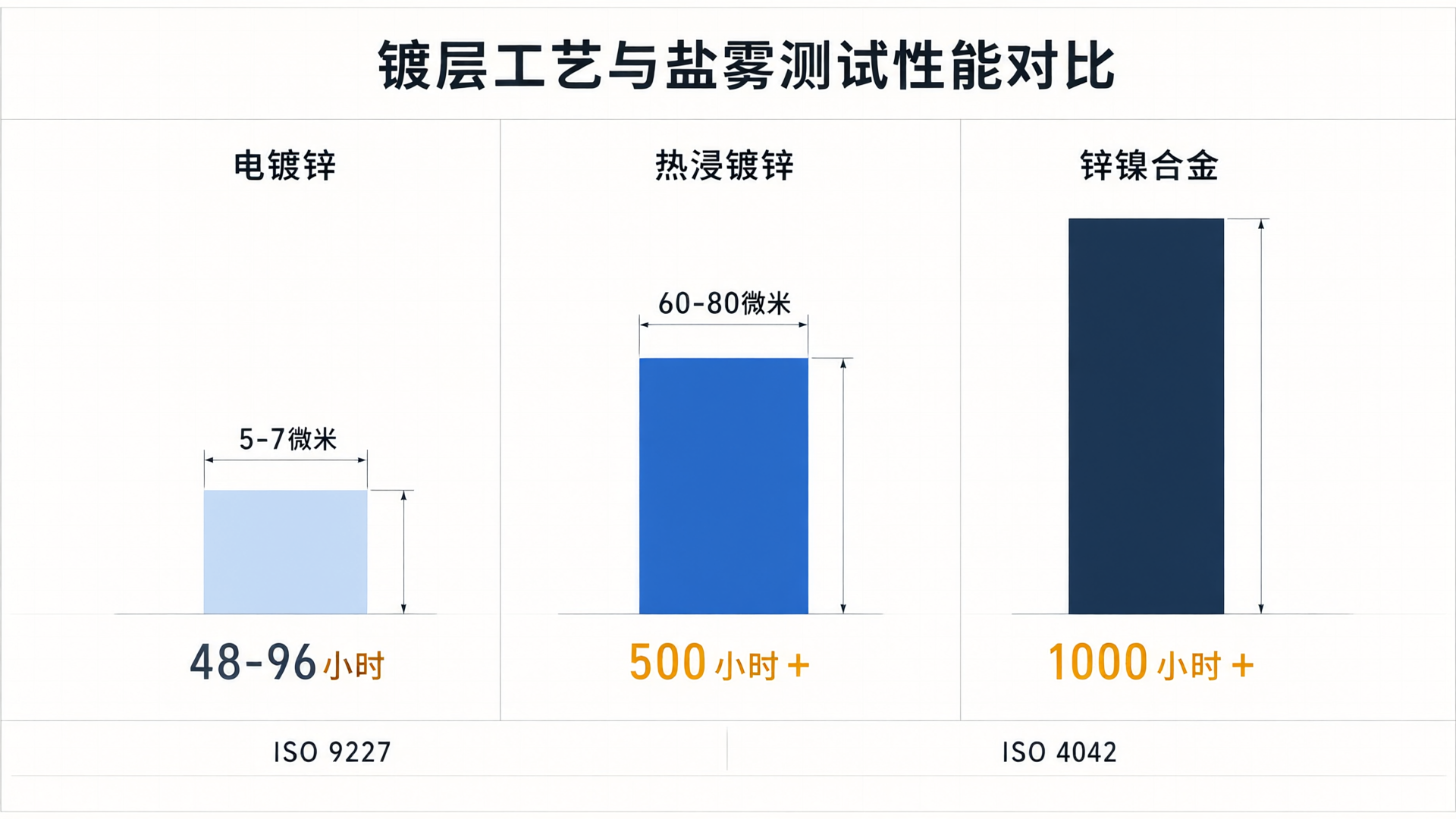
In Southeast Asian engineering procurement, tender documents typically require fasteners to pass 96 hours of NSS testing before site entry. For some coastal projects, the threshold is raised to 240 or even 500 hours. The plating process directly determines test results: electroplated zinc (5-7 µm) typically supports 48-96 hours of NSS, hot-dip galvanized (60-80 µm) can exceed 500 hours, and zinc-nickel alloy plating can surpass 1000 hours.
Scenario: Balancing Coating Grade and Cost
The onset time of red rust determines whether the base metal has begun to corrode; this is a mandatory acceptance criterion. Most tender documents for construction projects in Southeast Asia require fastener NSS testing to exceed 96 hours, a threshold that immediately disqualifies low-grade plating solutions.
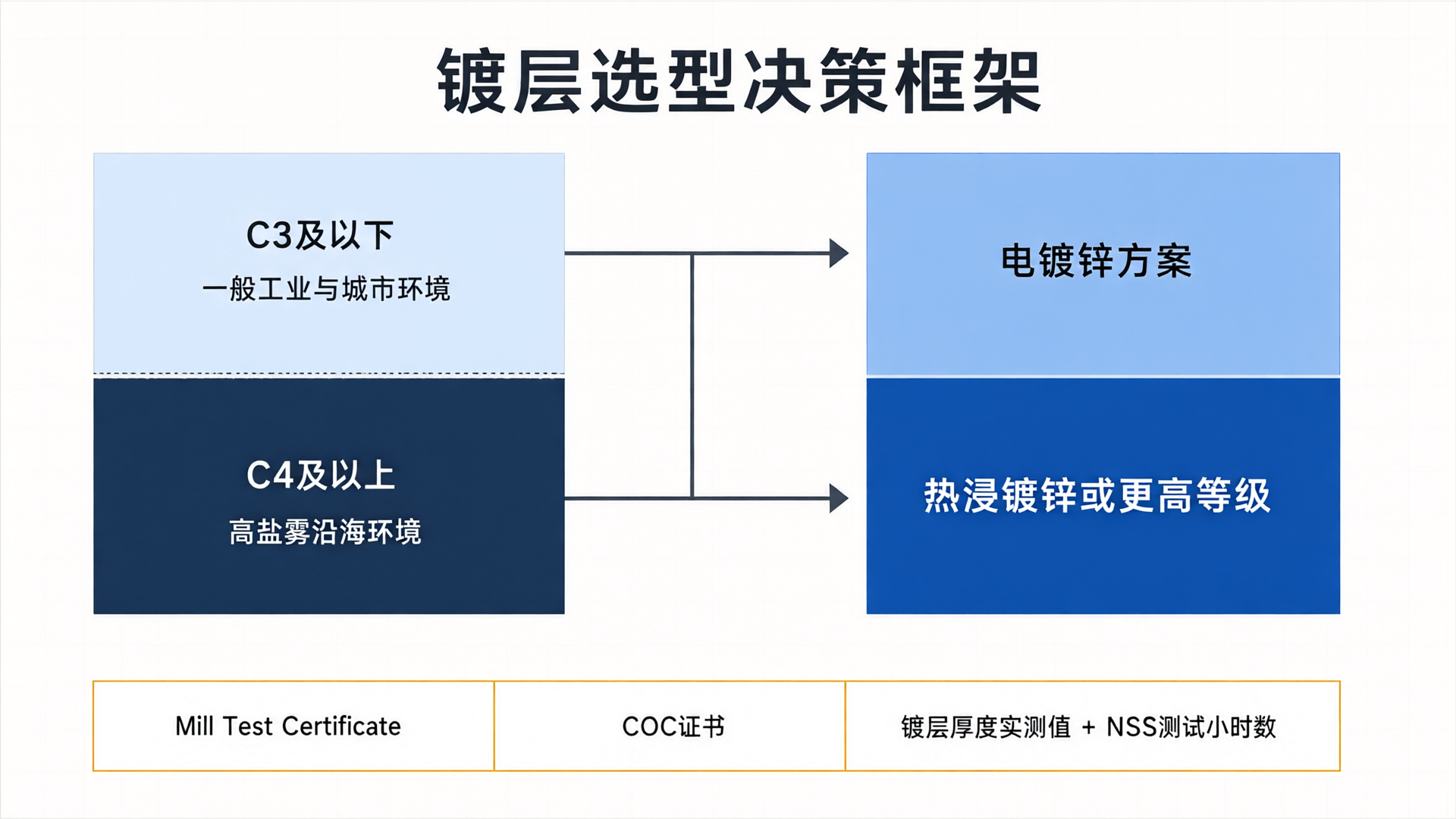
Taking a coastal construction project in Vietnam as an example: the initial design specified electro-galvanized bolts, but the site falls under C4 corrosion class (high salt-spray coastal environment per ISO 12944). We recommended switching to hot-dip galvanizing and increasing the coating thickness from the standard 60 microns to 80 microns. This adjustment raised NSS test results from 48 hours to over 500 hours. While unit costs increased by approximately 20%, this avoided future maintenance and replacement expenses due to corrosion. The partnership has lasted 4 years; all fasteners comply with ISO standards. Non-standard custom samples are delivered within 7 days, with annual procurement volume reaching 500 units.
Coating selection is fundamentally a trade-off between cost and service life. In Southeast Asian markets, electroplated zinc suffices for corrosion environments up to C3; C4 and above require hot-dip galvanizing or higher-grade solutions. Upon receiving the supplier's Mill Test Certificate and COC, buyers should prioritize verifying the actual coating thickness against NSS test hours rather than relying on generic statements like "compliant with ISO standards."
12 years of fastener industry experience, with expertise in international standards including ISO, DIN, and ANSI. Specialized in custom non-standard solutions and coating selection, having delivered projects for major construction sites across Southeast Asia.