In B2B procurement, choosing between standard fasteners and non-standard custom parts is fundamentally a trade-off between cost and lead time. These two product categories differ significantly in their cost structures and delivery logic; understanding these structural differences is essential for making an informed decision.
Cost Composition Comparison
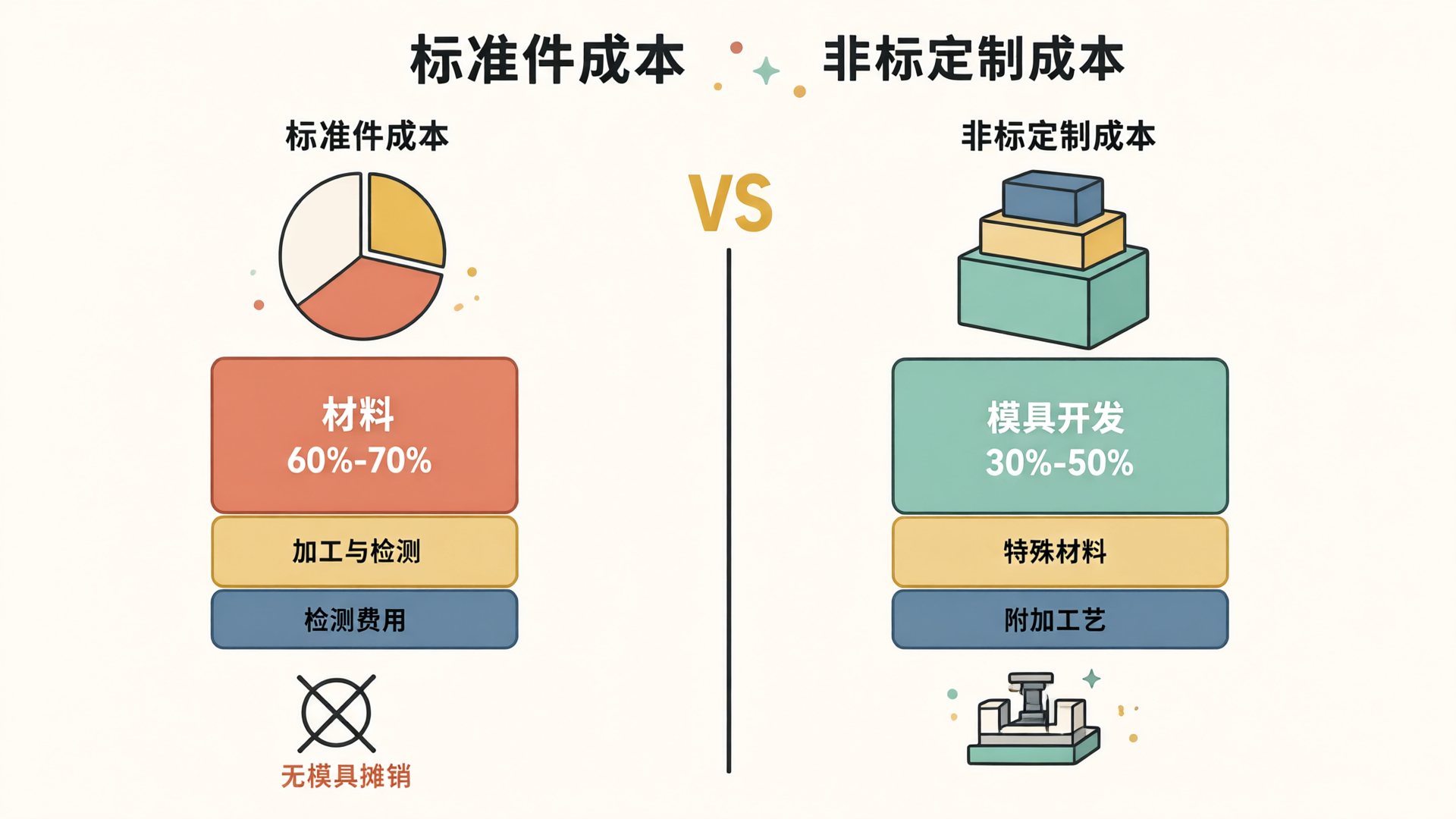
For standard parts, material costs are the core driver. Mature cold heading or machining processes enable scalable production: raw materials account for 60%–70% of unit cost, while processing and inspection expenses remain low. Higher purchase volumes yield lower unit prices, with no mold amortization required.
The cost structure for custom non-standard parts differs significantly. Mold development typically accounts for 30%–50% of total investment as a fixed cost. Materials may involve special-grade steel or alloys, carrying a higher unit price than standard components. Additional processes like surface treatment and secondary machining further increase costs. While the unit cost of non-standard parts decreases with larger production volumes, small-batch orders can result in prices 3–5 times higher than standard parts.
Delivery Variance Analysis
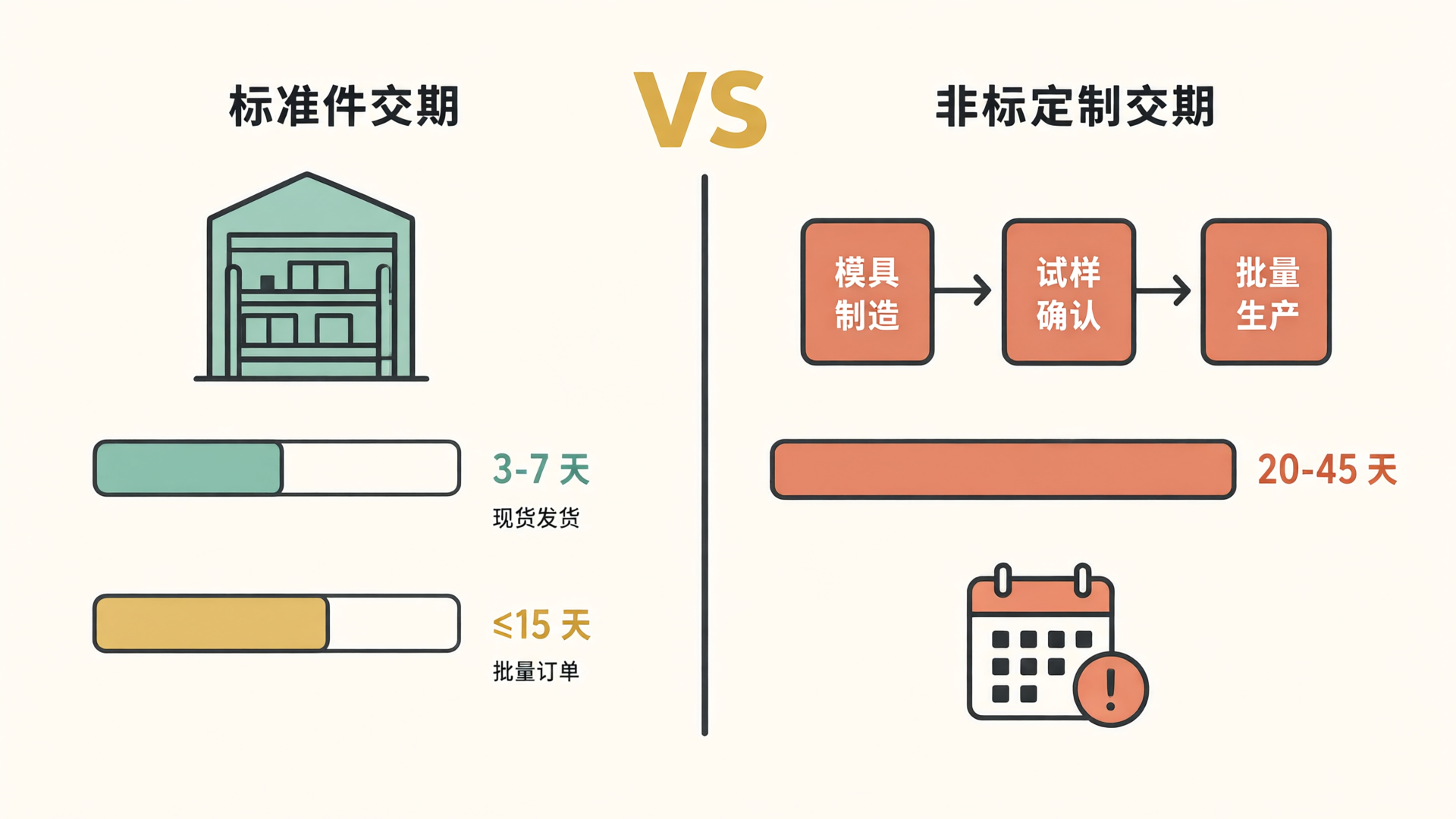
The advantage of standard parts lies in inventory. Common models (such as GB and DIN series) are typically stocked by most manufacturers, with shipment within 3–7 days after order placement; bulk orders usually ship within 15 days.
Lead time for custom non-standard orders includes mold manufacturing, sample confirmation, and mass production, typically spanning 20–45 days. Projects with high mold complexity or requiring multiple sample rounds may take longer.
Selection Decision Checklist
Procurement decisions can be quickly evaluated across three dimensions:
- Bulk: For annual demand under 5 10k units with no specialized performance requirements, prioritize standard parts. For demand exceeding 10 10k units with specific size or strength needs, custom tooling costs are effectively amortized.
- Lead Time: Projects with a lead time of 15 days or less require standard parts; for lead times exceeding 30 days, custom non-standard options have sufficient production scheduling flexibility.
- Total Cost: Standard parts have lower unit prices but may incur adaptation and modification costs. Non-standard parts require high upfront mold investments, yet mass production can reduce the per-unit cost to 1.2–1.5 times that of standard parts while eliminating secondary processing steps.
RuiYang SCM covers both standard fasteners and custom non-standard production lines. Custom prototyping takes approximately 7 days, with FAI first-article inspection reports and Mill Test Certificates provided to ensure traceability of material properties and dimensional accuracy for every batch.
Fastener selection has no absolute best choice; the key is aligning with your project's real constraints. Once you define demand volume, delivery window, and total budget, the right answer becomes clear.
12 years of fastener industry experience, with expertise in international standards including ISO, DIN, and ANSI. Specialized in custom non-standard solutions and coating selection, having delivered projects for major construction sites across Southeast Asia.